Appendices
Appendices
APPENDIX A1
CONGRESSIONAL ACTIONS
PUBLIC LAW 102-240-DEC. 18, 1991 (INTERMODAL SURFACE TRANSPORTATION EFFICIENCY ACT OF 1991)
Section 1077. REVISION OF MANUAL — Not later than 90 days after the date of the enactment of this Act, the Secretary shall revise the Manual of Uniform Traffic Control Devices and such other regulations and agreements of the Federal Highway Administration as may be necessary to authorize States and local governments, at their discretion, to install stop or yield signs at any rail-highway grade crossing without automatic traffic control devices with 2 or more trains operating across the rail-highway grade crossing per day.
PUBLIC LAW 102-388-OCT. 6, 1992 (DEPARTMENT OF TRANSPORTATION AND RELATED AGENCIES APPROPRIATIONS ACT, 1993)
Section 406 — The Secretary of Transportation shall revise the Manual of Uniform Traffic Control Devices to include — (a) a standard for a minimum level of retroreflectivity that must be maintained for pavement markings and signs, which shall apply to all roads open to public travel; and (b) a standard to define the roads that must have a centerline or edge lines or both, provided that in setting such standard the Secretary shall consider the functional classification of roads, traffic volumes, and the number and width of lanes.
PUBLIC LAW 104-59-NOV. 28, 1995 (NATIONAL HIGHWAY SYSTEM DESIGNATION ACT OF 1995)
Section 205. RELIEF FROM MANDATES — (c) METRIC REQUIREMENTS — (1) PLACEMENT AND MODIFICATION OF SIGNS — The Secretary shall not require the States to expend any Federal or State funds to construct, erect, or otherwise place or to modify any sign relating to a speed limit, distance, or other measurement on a highway for the purpose of having such sign establish such speed limit, distance, or other measurement using the metric system. (2) OTHER ACTIONS — Before September 30, 2000, the Secretary shall not require that any State use or plan to use the metric system with respect to designing or advertising, or preparing plans, specifications, estimates, or other documents, for a Federal-aid highway project eligible for assistance under title 23, United States Code. (3) DEFINITIONS — In this subsection, the following definitions apply: (A) HIGHWAY — The term ‘highway’ has the meaning such term has under section 101 of title 23, United States Code. (B) METRIC SYSTEM — the term ‘metric system’ has the meaning the term ‘metric system of measurement’ has under section 4 of the Metric Conversion Act of 1975 (15 U.S.C. 205c).
Section 306. MOTORIST CALL BOXES — Section 111 of title 23, United States Code, is amended by adding at the end the following: (c) MOTORIST CALL BOXES — (1) IN GENERAL — Notwithstanding subsection (a), a State may permit the placement of motorist call boxes on rights-of-way of the National Highway System. Such motorist call boxes may include the identification and sponsorship logos of such call boxes. (2) SPONSORSHIP LOGOS — (A) APPROVAL BY STATE AND LOCAL AGENCIES — All call box installations displaying sponsorship logos under this subsection shall be approved by the highway agencies having jurisdiction of the highway on which they are located. (B) SIZE ON BOX — A sponsorship logo may be placed on the call box in a dimension not to exceed the size of the call box or a total dimension in excess of 12 inches by 18 inches. (C) SIZE ON IDENTIFICATION SIGN — Sponsorship logos in a dimension not to exceed 12 inches by 30 inches may be displayed on a call box identification sign affixed to the call box post. (D) SPACING OF SIGNS — Sponsorship logos affixed to an identification sign on a call box post may be located on the rights-of-way at intervals not more frequently than 1 per every 5 miles. (E) DISTRIBUTION THROUGHOUT STATE — Within a State, at least 20 percent of the call boxes displaying sponsorship logos shall be located on highways outside of urbanized areas with a population greater than 50,000. (3) NONSAFETY HAZARDS — The call boxes and their location, posts, foundations, and mountings shall be consistent with requirements of the Manual on Uniform Traffic Control Devices or any requirements deemed necessary by the Secretary to assure that the call boxes shall not be a safety hazard to motorists.
Section 353(a) SIGNS — Traffic control signs referred to in the experimental project conducted in the State of Oregon in December 1991 shall be deemed to comply with the requirements of Section 2B-4 of the Manual on Uniform Traffic Control Devices of the Department of Transportation.
Section 353(b) STRIPES — Notwithstanding any other provision of law, a red, white, and blue center line in the Main Street of Bristol, Rhode Island, shall be deemed to comply with the requirements of Section 3B-1 of the Manual on Uniform Traffic Control Devices of the Department of Transportation.
PUBLIC LAW 115-141-MAR. 23, 2018 (CONSOLIDATED APPROPRIATIONS ACT, 2018)
DIVISION L, TITLE I
Section 125 — For this fiscal year, the Federal Highway Administration shall reinstate Interim Approval IA-5, relating to the provisional use of an alternative lettering style on certain highway guide signs, as it existed before its termination, as announced in the Federal Register on January 25, 2016 (81 Fed. Reg. 4083).
Option
Series E(modified)-Alternate may be used in place of Series E(modified) for the names of places, streets, and highways on freeway and expressway guide signs in accordance with the provisions of the following paragraph.
Standard
The use of Series E(modified)-Alternate shall be limited to the display of names of places, streets, and highways on freeway and expressway guide signs. Words shall be composed of lower-case letters with initial upper-case letters. The design and spacing of the letters shall be as provided in the “Standard Highway Signs” publication (see Section 1A.05 of this Manual). The nominal loop height of the lower-case letters shall be 84 percent of the height of the initial upper-case letter. Interline spacing, measured from the baseline of the upper line of legend to the upper limit of the initial upper-case letter of the lower line of legend, shall be at least 96 percent of the initial upper-case letters (equivalent to 84 percent of the initial upper-case letter when measured from the baseline of the upper line of legend to the upper limit of the rising stems of the lower-case letters of the lower line of legend). Edge spacing shall be as provided in Section 2E.13 of this Manual. The size of the sign shall be suitably enlarged to accommodate the larger lower-case letters and interline spacing. When the name of a place, street, or highway contains numerals, the numerals shall be composed of the FHWA Standard Alphabet Series E(modified). Other lettering on the sign, such as for cardinal directions and distance or action messages, and all numerals or special characters, shall be composed of Series B, C, D, E, E(modified), or F of the FHWA Standard Alphabets as provided in this Manual. Series E(modified)-Alternate shall not be used for any application other than as provided in the two preceding paragraphs.
APPENDIX A2
METRIC CONVERSIONS
Throughout this Manual all dimensions and distances are provided in English units. Tables A2-1 through A2-4 show the equivalent Metric (International System of Units) value for each of the English unit numerical values that are used in this Manual.
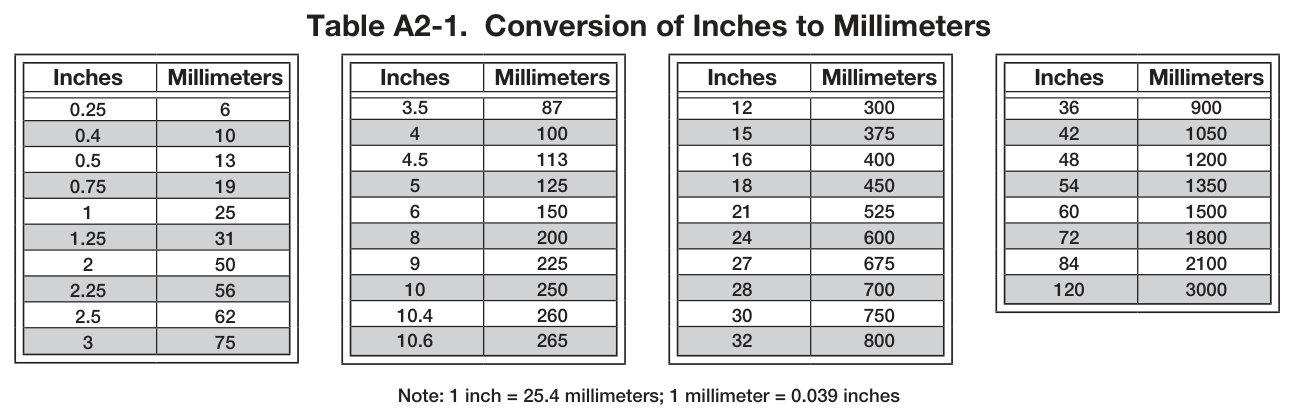
Table text from the official source
Column spacing follows the PDF. Use the image for merged cells and layout.
Table A2-1. Conversion of Inches to Millimeters
Inches   Millimeters        Inches      Millimeters              Inches        Millimeters   Inches   Millimeters
 0.25        6               3.5             87                     12              300       36         900
  0.4        10                4             100                    15              375       42         1050
  0.5        13               4.5            113                    16              400       48         1200
 0.75        19                5             125                    18              450       54         1350
   1         25                6             150                    21              525       60         1500
 1.25        31                8             200                    24              600       72         1800
   2         50                9             225                    27              675       84         2100
 2.25        56               10             250                    28              700       120        3000
  2.5        62              10.4            260                    30              750
   3         75              10.6            265                    32              800

                             Note: 1 inch = 25.4 millimeters; 1 millimeter = 0.039 inches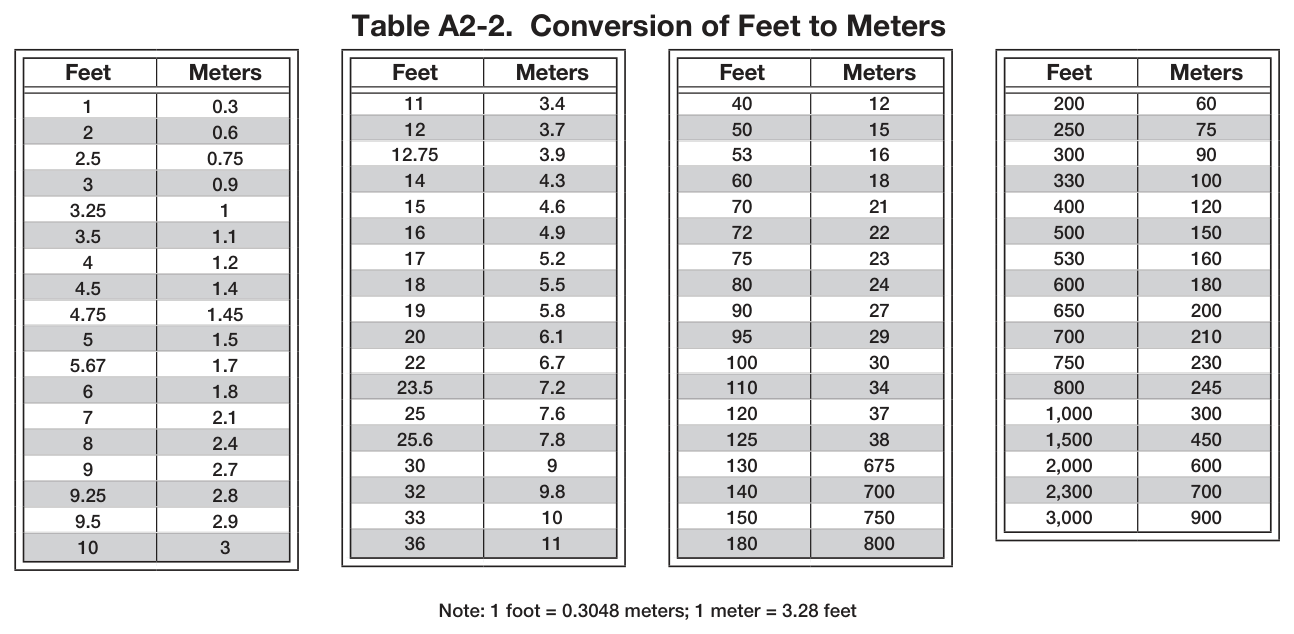
Table text from the official source
Column spacing follows the PDF. Use the image for merged cells and layout.
Table A2-2. Conversion of Feet to Meters
Feet   Meters     Feet             Meters                 Feet           Meters     Feet    Meters
  1      0.3        11               3.4                    40                 12    200     60
  2      0.6        12               3.7                    50                 15    250     75
 2.5    0.75      12.75              3.9                    53                 16    300     90
  3      0.9        14               4.3                    60                 18    330     100
3.25      1         15               4.6                    70                 21    400     120
 3.5     1.1        16               4.9                    72                 22    500     150
  4      1.2        17               5.2                    75                 23    530     160
 4.5     1.4        18               5.5                    80                 24    600     180
4.75    1.45        19               5.8                    90                 27    650     200
  5     1.5         20               6.1                    95                 29    700     210
5.67    1.7         22               6.7                   100                 30    750     230
  6     1.8        23.5              7.2                   110                 34    800     245
  7     2.1         25               7.6                   120                 37   1,000    300
  8     2.4        25.6              7.8                   125                 38   1,500    450
  9     2.7         30                9                    130                675   2,000    600
9.25    2.8         32               9.8                   140                700   2,300    700
 9.5    2.9         33               10                    150                750   3,000    900
 10       3         36               11                    180                800

                          Note: 1 foot = 0.3048 meters; 1 meter = 3.28 feet
Table text from the official source
Column spacing follows the PDF. Use the image for merged cells and layout.
Table A2-3. Conversion of Miles to Kilometers
Miles   Kilometers       Miles       Kilometers                Miles       Kilometers   Miles   Kilometers
0.25       0.4             1              1.6                    5               8       70        110
 0.5       0.8             2              3.2                    10              16
 0.6        1              3              4.8                    15              25

                           Note: 1 mile = 1.609 kilometers; 1 kilometer = 0.621 miles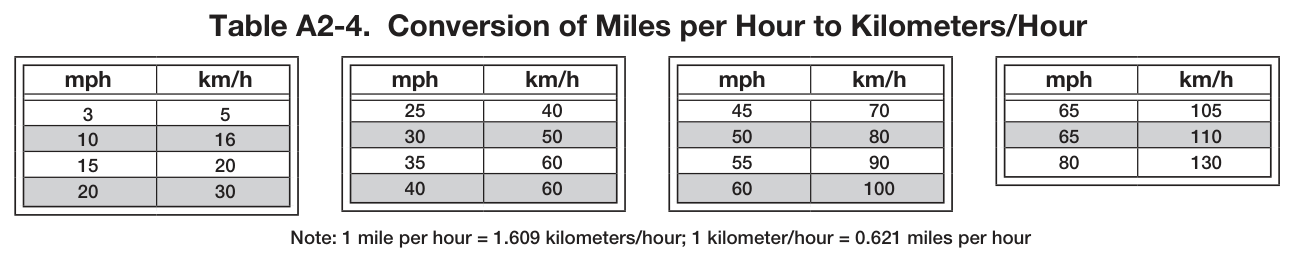
Table text from the official source
Column spacing follows the PDF. Use the image for merged cells and layout.
Table A2-4. Conversion of Miles per Hour to Kilometers/Hour
mph   km/h              mph             km/h                  mph             km/h                    mph   km/h
 3      5                 25              40                    45              70                    65    105
10     16                 30              50                    50              80                    65    110
15     20                 35              60                    55              90                    80    130
20     30                 40              60                    60             100

             Note: 1 mile per hour = 1.609 kilometers/hour; 1 kilometer/hour = 0.621 miles per hour